
How to See Jesus in the Old Testament Through Typology
We now come to the last of the ways that we can see Jesus in the Old Testament, typology. As I mentioned last week, typology and prophecy function like the hard poles on the spectrum of Christological interpretation. They are both cut and dry. With prophecy we look for a promise that is being made in the Old Testament and then we look for the fulfillment of that promise in Jesus. Thus we see Jesus prefigured in these prophetic promises.
Typology functions in a similar way to this, but instead of looking at promises it looks at symbols. These symbols are called “types” hence the name typology. Vern Poythress defines a type like this, “A type is a symbol specifically designed by God to point forward to a fulfillment.”[1] To put this another way, typology is looking at Old Testament rituals, institutions, and offices which find their true meaning in Jesus Christ. Therefore, we could map our three methods of seeing Jesus in the Old Testament along a spectrum.
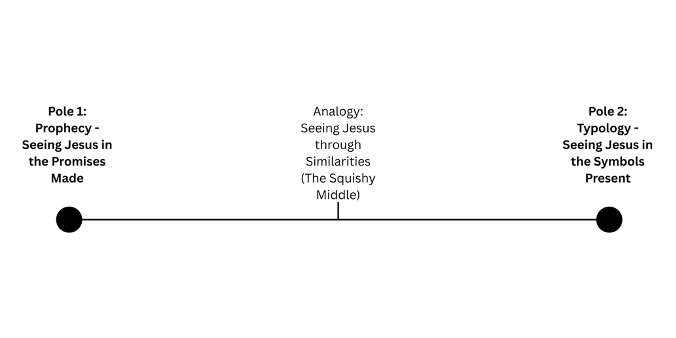
Pole 1 represents seeing Jesus prophetically, Pole 2 represents seeing Jesus typologically, and seeing Jesus analogically fits in between these two poles.
Similar to our other methods of seeing Jesus we need to be cautious in how we utilize typology. We never want to make the Bible say something it did not intend to say. To protect against this, I have devised two questions which can help us. First, what does this Old Testament type symbolize? We begin by taking the Old Testament at face value. Second, how is Jesus the fulfillment of this symbol in the New Testament? We then go to the New Testament and see how Jesus brings this symbol to completion. Let’s consider an example to help us understand how this works.
Consider the tabernacle/temple in the Old Testament. The first question we need to ask is, “what does this Old Testament type symbolize?” To answer this we need to go to a number of passages which speak of the tabernacle. First, we should consider what takes place after the completion of the tabernacle in Exodus. After the construction of the tabernacle is finished a cloud, representing God’s presence with the Israelites, fills the tabernacle. We read, “For the cloud of the Lord was on the tabernacle by day, and fire was in it by night, in the sight of all the house of Israel through all their journeys.” (Ex 40:38) Likewise, when Solomon completes the construction of a permanent temple in Jerusalem this same cloud fills it; “And when the priests came out of the Holy Place, a cloud filled the house of the Lord, so that the priests could not minister because of the cloud, for the glory of the Lord filled the house of the Lord.” (1 Kings 8:10–11) From this we learn that the tabernacle/temple is the place where the Lord dwells among his people. It represents his presence with them. Therefore, we could answer our first question like this; the tabernacle/temple symbolizes the presence of God with his people.
We then need to answer our second question, “how is Jesus the fulfillment of this symbol in the New Testament?” Let’s consider what we learn about Jesus there. When we turn to the New Testament we learn that Jesus is God incarnate. We see this in passages like Colossians 1:15–20. In verse 19 we read that in Jesus “all the fullness of God was pleased to dwell.” Paul makes a similar statement in Philippians 2:5–7, “Have this mind among yourselves, which is yours in Christ Jesus, who though he was in the form of God, did not count equality with God a thing to be grasped, but emptied himself by taking the form of a servant, being born in the likeness of men.” Jesus Christ, the fully divine Son of God, became a man. The author of Hebrews argues that Jesus is “the radiance of the glory of God and the exact imprint of his nature.” (1:3) The clincher of all of this can be found in John 1:14, “And the Word became flesh and dwelt among us.” John is speaking of Jesus here as the eternal Word. Previously, John wrote that this Word “was with God” and “was God.” (John 1:1) This Word “dwelt among us,” he became one of us, and in doing so God was literally present with us.
We begin to see now how Jesus fulfills the symbol of the temple. We could answer our second question like this; Jesus fulfills the symbol of the tabernacle/temple by being God and being physically present with his people. Putting all of the above together, we could say that the temple was always a symbol which was meant to point beyond itself to the presence of God in Jesus Christ.
I would like you to try this on your own now. For a symbol I would like you to look at the priesthood. This is what makes typology a lot harder than our other categories. You need to have a good grasp of what the whole Old Testament says about the symbol to answer the first question. Likewise, you need a broad enough grasp of the New Testament to show how Jesus is its fulfillment. To do this, begin by going to the back of your Bible and look at the concordance. Look for the word “priest” and then go to the verses it lists. You may even need to go online and utilize an online concordance like Open Bible. Look at the Old Testament references and attempt to summarize what the priesthood symbolizes. After you have done this, go to the New Testament and do the same thing. Try to figure out how Jesus is the fulfillment of what the priesthood symbolized in the Old. As you do this process you should begin to see how Jesus is the great high priest who sacrificed himself for our sins.
Conclusion
Over the past four weeks I have been trying to show you methods for seeing Jesus in the Old Testament. But you might be wondering, “who cares?” That is a valid question. Why should we care about seeing Jesus in the Old Testament? Unfortunately, for many Christians the Old Testament remains an obscure, impractical, and mysterious part of Bible reading. This is sad! The Old Testament lays the foundation for comprehending God’s plan of redemption in Jesus Christ. Once people fell into sin, God set his plan in motion to save them. This plan finds its culmination in the life, death, and resurrection of Jesus. This plan was in motion from the beginning, meaning we can see ways that God is leading people towards, pointing them to, and preparing them for a coming Messiah in Jesus Christ. When we learn to see Jesus in the Old Testament, suddenly Scripture is opened for us as a unified book about our great Savior. So let’s savor the Old Testament together.
[1] Poythress, Biblical Typology, 1.